
Share Elizabeth Anne Featherstone Hoff's obituary with others.
Invite friends and family to read the obituary and add memories.
Stay updated
We'll notify you when service details or new memories are added.
You're now following this obituary
We'll email you when there are updates.
Select your format and elements to print

IN LOVING MEMORY OF Elizabeth Anne Featherstone Hoff
Elizabeth Anne
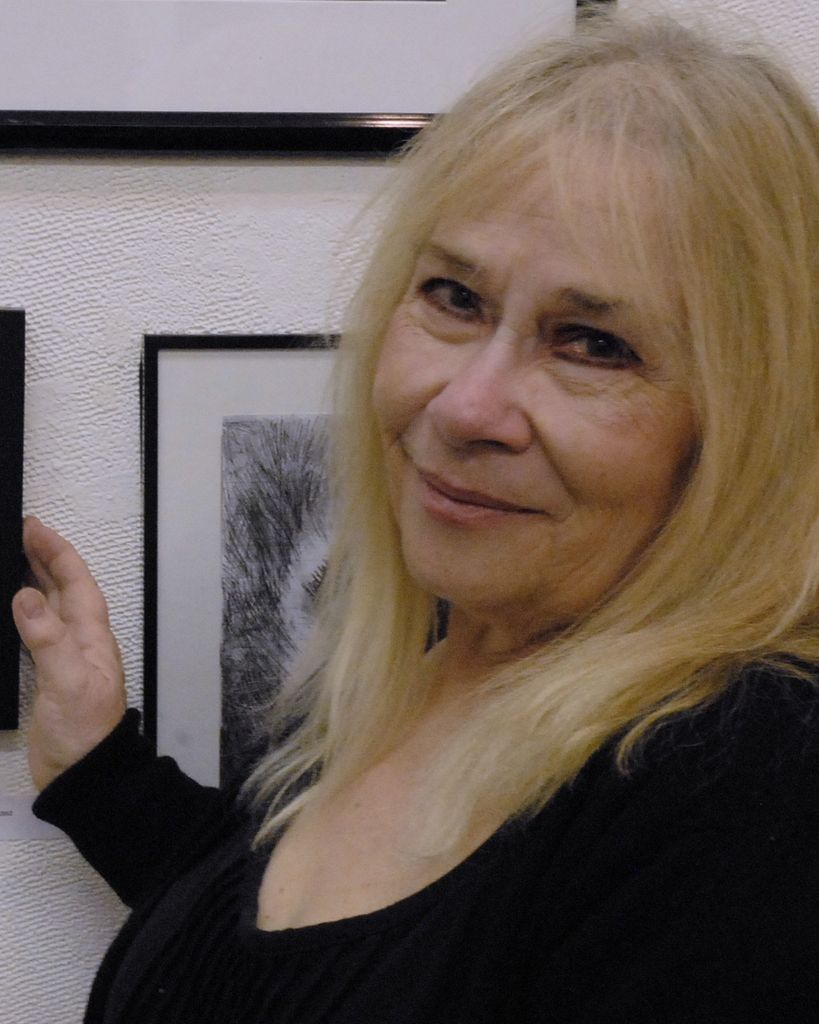
Featherstone Hoff
Apr 10, 1945 — Feb 19, 2026
Melrose
Elizabeth Anne Featherstone Hoff's Obituary
Elizabeth Anne Featherstone Hoff
April 10, 1945-February 19, 2026
Artist, poet, wife, mother, and grandmother Elizabeth Featherstone Hoff died early in the morning of February 19, 2026, from complications of Alzheimer’s disease. She was 80 years old.
Also known professionally as e. featherstone hoff, she worked for nearly three decades as a sculptor, painter, and printmaker. Her works were shown in galleries in New York City, Baltimore, MD, and Washington, D.C., as well as in juried and invitational shows, international exhibitions, books, and magazines, which also featured her poetry.
Born in Minneapolis, MN to James Wesley Featherstone II and Mary Eleanor (Maloney), she grew up in Alexandria, Virginia, where her father worked as a senior civil servant with the federal government. She attended St. Agnes School and was a graduate of George Washington High School. She spent her early youth studying under painter Jennie Lea Knight and performing her own poetry in Washington, D.C., where she also met her jazz musician husband. Following their marriage in 1965, she and her husband lived briefly in the D.C. area and in Boston, MA. In 1968, they moved to New York City and shortly thereafter joined and traveled with the jazz rock band Ten Wheel Drive (TWD), fronted by Genya Ravan. On the first TWD album, “Construction #1” (1969), she and her husband wrote and composed, respectively, “Candy Man Blues,” a ballad banned on Boston radio stations at the time for its use of the word “bastard.”
After leaving TWD in 1970, Elizabeth and her husband wrote and recorded for a music publisher. In 1973, they moved to Staten Island, NY, and for many years she built a life centered on music, art, books, Episcopal church activities, gardening, writing poetry and song lyrics, and raising two daughters. Her own artistry was an indelible part of this life. In the mid-1980s, despite now-chronic pain, she started her professional career in earnest, beginning with printmaking studies under teacher Herman Zaage at The Art Lab at Snug Harbor on Staten Island. She never again lived without a studio space in her home.
Upon moving back to northern Virginia with her family in 1989, she studied again with Jennie Lea Knight and was taught and mentored by sculptor Anne Truitt. She also studied and worked at the Art League School associated with the Torpedo
Factory in Alexandria, VA. It was there she dove deep into the art and science of kiln firing ceramics. Ultimately, she expanded her studio to include a kiln of her own so that she could experiment and create in sculpture clay without constraint.
Ranging in size from tiny works on paper to large canvases to life-sized mixed media pieces in clay, wood, and metal, her art never strayed far from the human figure. Through these works she sought to express her life and experience as a woman and a mother, pain and brokenness, and exuberant joy in creation. As she explained in the Fall 2004 issue of “Sculptural Pursuit” magazine, “Through the use of line, dimension, and color, I peel away the outer layers of skin and explore the myriad worlds of emotional nuance that lie beneath.” Although she loved painting and never stopped, clay was indeed her deepest love, and she identified herself primarily as a sculptor. Some of her many influences included Frida Kahlo, Käthe Kollwitz, Pablo Picasso, Paul Gaugin, Edgar Degas, Louise Bourgeois, Romare Bearden, Hans Bellmer, Francisco Goya, Francis Bacon, Jean-Michel Basquiat, William Blake, and Henri Matisse, as well as centuries of work by artists and artisans in South and Central America and Africa whose names have been lost or never attributed. She was also deeply influenced by the landscape, people, and stories from her childhood in what was then a rural area in northern Virginia.
She also did not shy away from explicitly political themes in her work, such as the impact of gun violence on children; a sculpture she titled “Madonna of the NRA” featured prominently in a two-woman show in Washington, D.C.
Her diagnosis and treatment for breast cancer in the mid-1990s, as well as multiple surgeries to address pain and mobility issues, only increased her determination to create and have her work recognized. In 2012, she achieved a lifelong dream of being part of a Manhattan gallery in New York when she joined Viridian Artists. With her husband, she moved back to Staten Island in 2014, where they sought to continue their art and music careers. However, as the onset and progression of Alzheimer’s disease tragically robbed her of her ability to make art, in 2021 they moved one last time to Melrose, MA, to be with family. She spent her final years in the compassionate care of The Lighthouse in Revere, MA.
During her life, the passion that Elizabeth poured into her art was matched only by that which she gave to her family. She lived and loved fiercely. She was quick-witted and had a tremendous sense of humor—a quality she also valued in others. Her ability to win an argument was unparalleled, much to the chagrin of her daughters during their adolescence and ever after. She worked hard to raise her girls to become strong, self-confident women who could be independent in the
world, and was immensely proud of them. She championed and supported her husband in his music career and through professional and personal challenges. While she often pleaded guilty to being “difficult,” at the same time she was a romantic and an optimist. A self-identified introvert who struggled with many fears, she nonetheless drew people to her through conversation and careful listening, and her arms and heart were open to all the children in her extended family.
Her drive to create and her capacity to nurture were also reflected in many other aspects of her life—her cooking, how she dressed and carried herself, her love of makeup, her depictions of beloved cats and other animals, and the gardens she created with her husband everywhere they lived. As a southerner, she was very proud not only to receive an authentic Italian cheesecake recipe from neighbors in New York, but also to perfect its execution—much to everyone’s delight. In her tendency to sudden and extreme enthusiasms, she saw in herself a kindred spirit to Mr. Toad in the children’s book “The Wind in the Willows,” such that the line “A motor car!” became a cherished mantra—and a signal to the family of what might be coming.
She is survived by those bereft of her twice, first from a cruel disease and second by her physical death: Her loving and devoted husband of 60 years, Louie E. Hoff of Melrose, MA; daughter Sarah B. Hoff and her husband Reed C. Harmon of Melrose, MA; daughter Eleanor F. Hoff and her husband Andrew S. Liebeskind of Wakefield, MA; granddaughters Elizabeth G. and Eleanor L. Harmon-Hoff of Melrose, MA; sister Phyllis J. Featherstone of Staten Island, NY, and her children Helen Vermillion, Ben Brooks, and Ed Brooks; brother James W. Featherstone III and his wife Betsy Featherstone of Richmond, VA, and their children Mary Purnell, Margaret Thomas, James W. Featherstone IV, Carrie Hoge, and Andrew Featherstone; many grand-nieces and grand-nephews; and numerous friends and colleagues whose lives she touched over the years.
“Physical handicap does not handicap purpose in life”—note written in E. F. Hoff personal book
Elizabeth Anne Featherstone Hoff's Guestbook
Visits: 400
This site is protected by reCAPTCHA and the
Google Privacy Policy and Terms of Service apply.
Service map data © OpenStreetMap contributors